Key takeaways
- Google estimates its median Gemini text prompt uses 0.24 Wh of electricity and 0.26 mL of water on site, a figure that excludes water used at power plants.
- Berkeley Lab estimates US data centers consumed about 66 billion liters of water directly for cooling in 2023, plus nearly 800 billion liters indirectly through electricity generation.
- US data centers used 4.4% of the nation's electricity in 2023 and could reach 6.7% to 12% by 2028, so their water demand is likely to keep rising with power use.
In this story 9 sections
- The key numbers at a glance
- Why AI needs water in the first place
- What the 0.26 mL per prompt figure actually covers
- Where the 66 billion liters goes
- Why the indirect 800 billion liters is bigger
- What 4.4% of US electricity tells you
- The 5 million gallon local problem
- A worked example: one heavy user for a year
- How to use these numbers
Ask a chatbot one question and, according to Google, the data center behind it uses about five drops of water. That sounds tiny, and for a single prompt it is. So how does AI use water at all, and why do whole towns end up arguing about it? The answer comes down to heat, electricity and scale. Here are the figures that matter, where each one comes from, and what they look like when you multiply them out.
The key numbers at a glance
- 0.26 mL: water used on site for the median Gemini text prompt, by Google's own estimate.
- 0.24 Wh: electricity for that same median prompt, about as much as a TV uses in under nine seconds.
- 66 billion liters: water US data centers consumed directly for cooling in 2023, per Lawrence Berkeley National Laboratory.
- About 800 billion liters: the indirect water tied to the electricity those data centers used in 2023.
- 4.4%: the share of all US electricity data centers used in 2023 (176 TWh).
- 6.7% to 12%: the share of US electricity data centers could use by 2028.
- Up to 5 million gallons a day: what a single large data center can consume, according to the Environmental and Energy Study Institute.
Why AI needs water in the first place
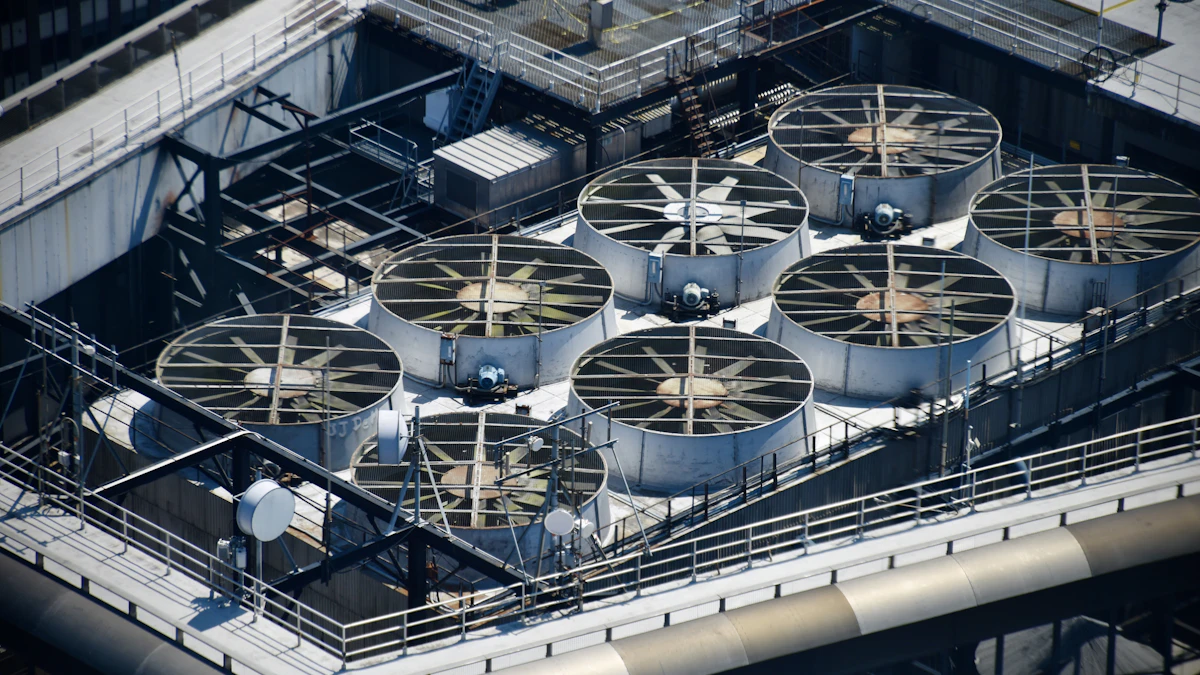
AI models run on racks of specialized chips that turn nearly all of their electricity into heat. That heat has to go somewhere, or the hardware slows down and fails. Many data centers handle it the way your body does on a hot day: they let water evaporate. Warm water from the cooling system passes through towers where some of it evaporates, carrying heat away with it.
That evaporation is the main reason AI "drinks" water. The Environmental and Energy Study Institute (EESI) reports that roughly 80% of the water data centers withdraw evaporates, with the rest sent to wastewater treatment. EESI notes that evaporative air cooling is the more water intensive approach, while other facilities cool servers with liquid instead.
There is a second, hidden source of water use too. Power plants that burn gas or coal, or run on nuclear, also boil and evaporate water to make electricity. So every kilowatt hour a data center pulls from the grid carries some water with it, even if the building itself uses none. This is the "AI uses water and energy" connection people search for: the two are tied together.
What the 0.26 mL per prompt figure actually covers
In August 2025, Google published estimates for the median text prompt in its Gemini apps: 0.24 watt hours of energy, 0.03 grams of carbon dioxide equivalent and 0.26 milliliters of water. Google says this method counts the chips doing the work, idle machines kept ready for traffic spikes, the host computers' processors and memory, and cooling overhead.
A few caveats are worth knowing. The water figure covers water consumed at Google's data centers. It does not include the water used by power plants to generate the electricity. Google also notes the numbers have not been verified by an independent third party, and they describe a median text prompt, not image generation, video or long research tasks, which can take much more computing.
Google also reported that the energy used by its median Gemini prompt fell by 33 times between May 2024 and May 2025. Efficiency is improving fast, which is part of why per prompt numbers from a couple of years ago often look much higher.
Where the 66 billion liters goes
The 2024 United States Data Center Energy Usage Report from Lawrence Berkeley National Laboratory estimates that US data centers consumed about 66 billion liters (roughly 17.4 billion gallons) of water on site in 2023. That is more than triple the 21.2 billion liters it estimated for 2014.
The report says hyperscale and colocation facilities, the giant buildings run by cloud companies and the shared sites that rent space to them, accounted for 84% of that total. These are exactly the places where AI training and inference happen. Looking ahead, the lab projects hyperscale data centers alone could consume between 60 and 124 billion liters in 2028.
The same report puts average on site water use at just over 0.36 liters per kilowatt hour through 2023, rising to between 0.45 and 0.48 liters per kilowatt hour afterward as facilities change.
Why the indirect 800 billion liters is bigger
The indirect number dwarfs the direct one. Berkeley Lab estimates the electricity US data centers used in 2023 accounted for nearly 800 billion liters of water consumed at power plants, or about 4.52 liters per kilowatt hour on average. That is slightly above the overall US average of 4.35 liters per kilowatt hour.
In plain terms, most of AI's water footprint usually sits upstream at the power plant, not in the data center's cooling towers. A data center powered largely by wind and solar has a much smaller indirect footprint than one drawing from a grid heavy on thermal plants.
What 4.4% of US electricity tells you
According to Berkeley Lab, data centers used about 176 terawatt hours in 2023, or 4.4% of all US electricity, up from 58 TWh in 2014. The lab expects 325 to 580 TWh by 2028, which would be 6.7% to 12% of the nation's power. AI servers are a major driver of that growth.
Globally, the International Energy Agency says data center electricity demand rose 17% in 2025 and is set to double by 2030, with AI focused facilities possibly tripling. Since water use follows electricity, both direct and indirect water demand tend to climb with it.
The 5 million gallon local problem
National totals hide the part that matters most to neighbors. EESI reports that a large data center can use up to 5 million gallons a day, comparable to a town of 10,000 to 50,000 people. A medium facility can use about 110 million gallons a year for cooling.
This is where the common question "if the water cycle exists, why does it matter?" comes in. Evaporated water does return as rain eventually, but not necessarily to the same river or aquifer, and not on the schedule a dry region needs. EESI says the water data centers withdraw is typically freshwater from local supplies. A data center in a water stressed area competes with homes and farms for that supply now, regardless of where the vapor lands later. That local strain is a big part of why data center projects keep showing up in community fights over new sites.
A worked example: one heavy user for a year
Say you send 1,000 short text prompts a day to an AI chatbot, every day for a year. Using Google's median figures as a rough guide:
- Prompts per year: 1,000 × 365 = 365,000.
- On site water: 365,000 × 0.26 mL = 94,900 mL, or about 95 liters (around 25 gallons).
- Electricity: 365,000 × 0.24 Wh = 87,600 Wh, or 87.6 kWh.
- Indirect water at the Berkeley Lab average: 87.6 kWh × 4.52 L/kWh = about 396 liters (around 105 gallons).
- Total: 95 + 396 = about 491 liters, or roughly 130 gallons for the year.
The point is not that your chatbot habit is a crisis. It is that billions of prompts, plus model training and heavier tasks like image and video generation, add up to the national figures above. Your own numbers could also differ a lot, since providers, models, task types and local grids vary.
How to use these numbers
When you see a claim about AI and water, check three things: whether it counts only on site cooling or also power plant water, whether it refers to a single text prompt or to training and heavy workloads, and how old the estimate is. Those choices can change a figure by a wide margin.
If you want to cut your own footprint, shorter prompts and fewer regenerations help a little, and choosing tools that publish their energy and water data helps more. For background on what happens when you type a prompt, see our guides on what a large language model is, how AI tokens work and generative AI basics. You can find more explainers in our AI section.
Sources
- Google Cloud: Measuring the environmental impact of AI inference
- Lawrence Berkeley National Laboratory: 2024 United States Data Center Energy Usage Report
- Berkeley Lab News Center: Report evaluates increase in electricity demand from data centers
- International Energy Agency: Data centre electricity use surged in 2025
- EESI: Data Centers and Water Consumption
Share this story
Spotted an error? Tell us